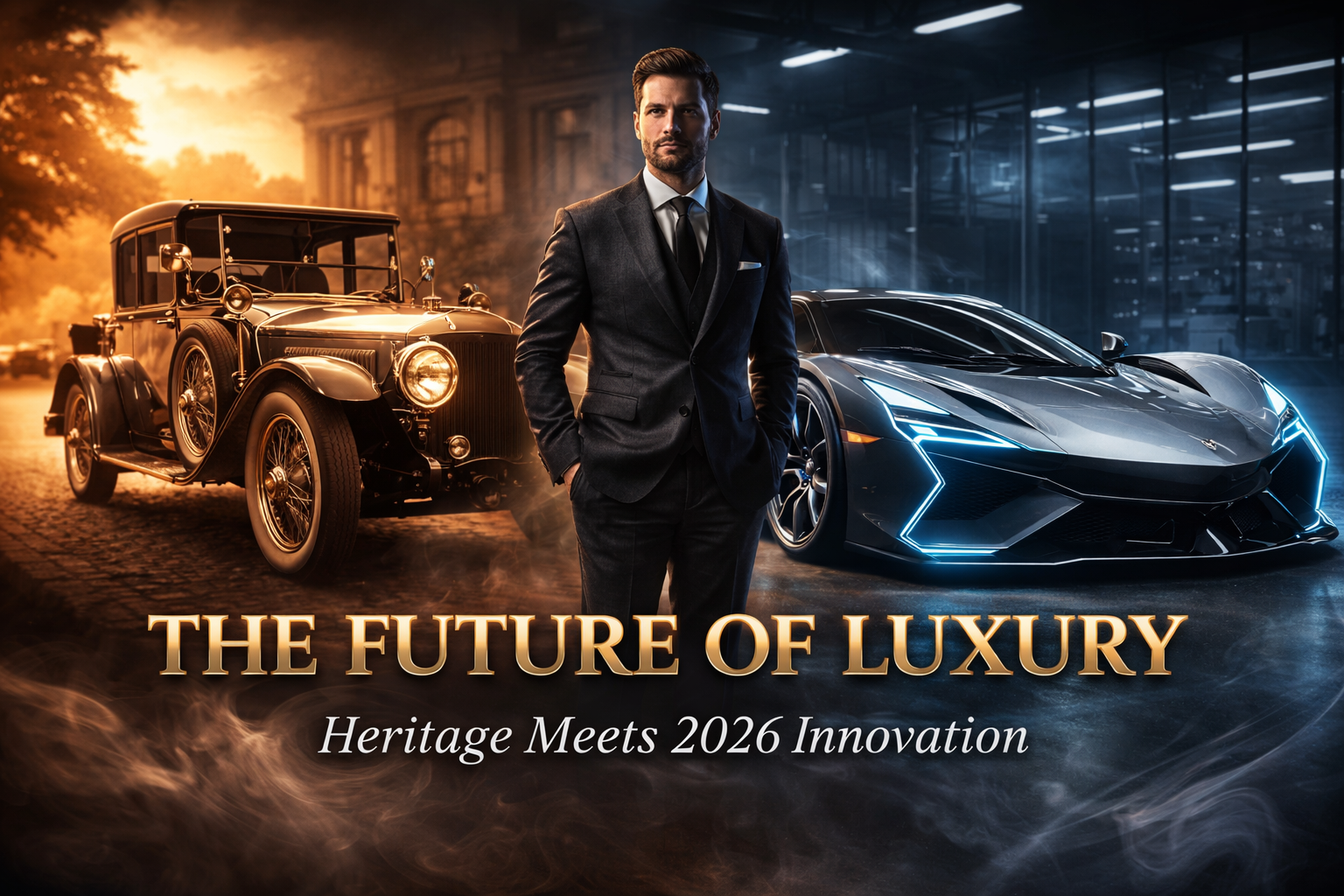
Introduction: The Shift from Horsepower to Brainpower
In the high-octane world of automotive excellence, we are standing at the edge of a total transformation. The future of luxury cars is no longer defined by how loud an engine roars, but by how silently and intelligently a vehicle can transport its inhabitants. As we move past 2026, the traditional “internal combustion” era is fading, making way for a “Digital Sanctuary” on wheels.
Luxury is evolving from mechanical performance into “experiential transcendence.” A car is no longer just a mode of transport; it is becoming a mobile office, a private cinema, and a high-yield investment asset. This article explores the rich history of automotive opulence, compares the legends of the past with the titans of 2026, and reveals the revolutionary features that will define the next decade of driving.
1. The Heritage of High-End Motion: A Brief History
To understand the future of luxury cars, we must look back at the pioneers who defined “Premium.” In the early 1900s, luxury meant the Rolls-Royce Silver Ghost—a car so quiet and smooth it was dubbed “The Best Car in the World.” During this era, luxury was about massive engines and heavy coachbuilt bodies made of wood and steel.
By the 1950s and 60s, brands like Mercedes-Benz introduced the 300SL Gullwing, merging racing performance with high-end comfort. This was the era of “Grand Touring.” Cars were built for the elite to travel across continents in total comfort. Fast forward to the 1990s, and the introduction of the McLaren F1 and Bugatti EB110 shifted the focus toward “Hyper-Luxury,” where speed became the ultimate status symbol.
2. Comparative Analysis: Classic Legends vs. Future Titans
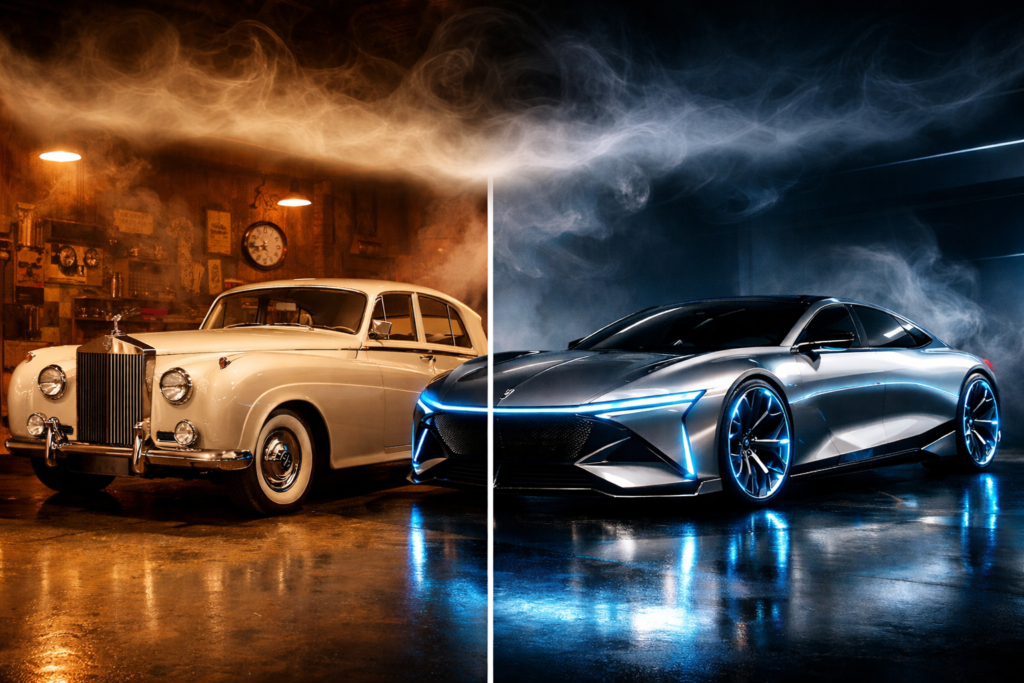
The future of luxury cars represents a 180-degree turn in engineering philosophy.
| Feature | The Classic Era (1960-2010) | The Future Era (2026+) |
| Powertrain | Massive V12 / V16 Petrol Engines. | Solid-State Batteries & Hydrogen Fuel Cells. |
| Interior | Exotic Animal Leathers & Rare Woods. | Sustainable Mushroom Silk & Recycled Ocean Plastic. |
| Control | Purely Manual / Analog Dials. | AI-Gesture Control & Neural Link Interfaces. |
| Driving | Driver-Centric (Human Control). | Level 5 Fully Autonomous (Self-Driving). |
| Connectivity | Radio / CD Player / Physical GPS. | 6G Integrated Cloud & Augmented Reality Windshields. |
3. Revolutionary Features: What’s Coming Post-2026?
The future of luxury cars will be defined by three pillars: Sustainability, Autonomy, and Connectivity.
A. Solid-State Battery Technology
By 2027, companies like Toyota and Volkswagen plan to debut Solid-State Batteries. Unlike current lithium-ion batteries, these will charge in under 10 minutes and provide a range of over 1,000 kilometers. This removes “range anxiety” from the luxury experience entirely.
B. The “Lounge Interior” Concept
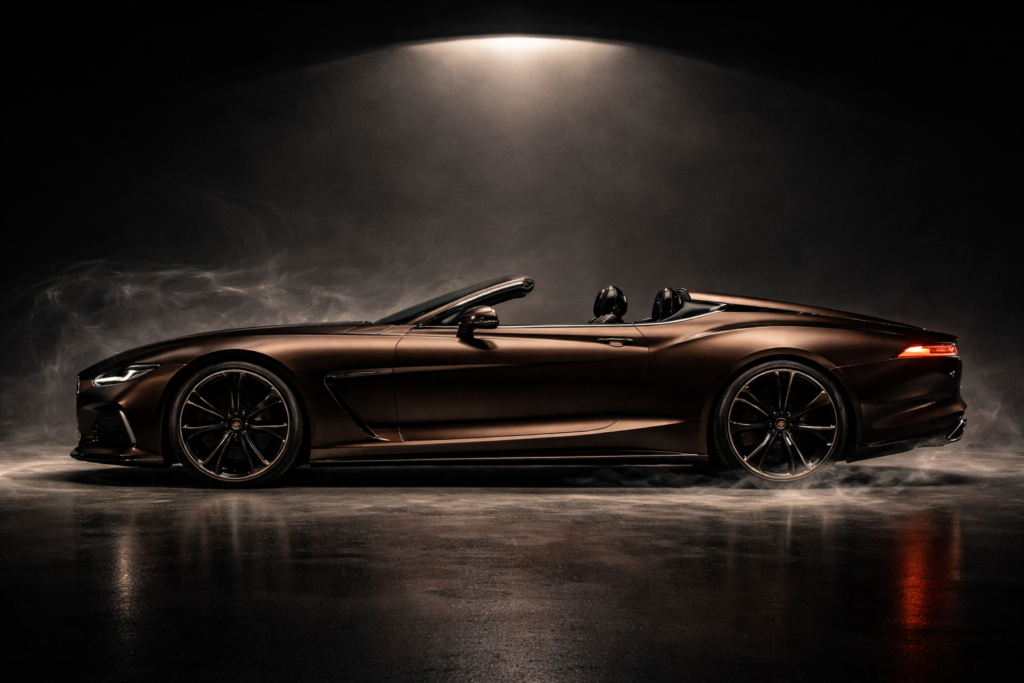
Since cars will soon drive themselves (Level 4/5 Autonomy), steering wheels will become optional. The future of luxury cars involves seats that can rotate 180 degrees to face each other, turning the cabin into a mobile boardroom or a relaxation lounge. Brands like Bentley are already showcasing concepts where the glass windows act as giant 8K touchscreens.
C. Biometric Health Monitoring
Post-2026 luxury vehicles will act as your personal doctor. Sensors in the seats will monitor your heart rate, stress levels, and blood oxygen. If the car detects you are stressed, it will automatically adjust the ambient lighting, release calming scents (Aromatherapy), and activate a therapeutic massage.
4. The “Big Three” Roadmap: Rolls-Royce, Ferrari, and Lamborghini
How are the world’s most prestigious brands preparing for the future of luxury cars?
Rolls-Royce: The Silent Spectre
With the launch of the Spectre, Rolls-Royce has committed to going fully electric by 2030. Their strategy for 2026 is “Digital Bespoke.” Every car will have its own AI avatar that learns the owner’s habits—from their favorite temperature to their preferred morning news briefings.
Ferrari: The Electric Emotion
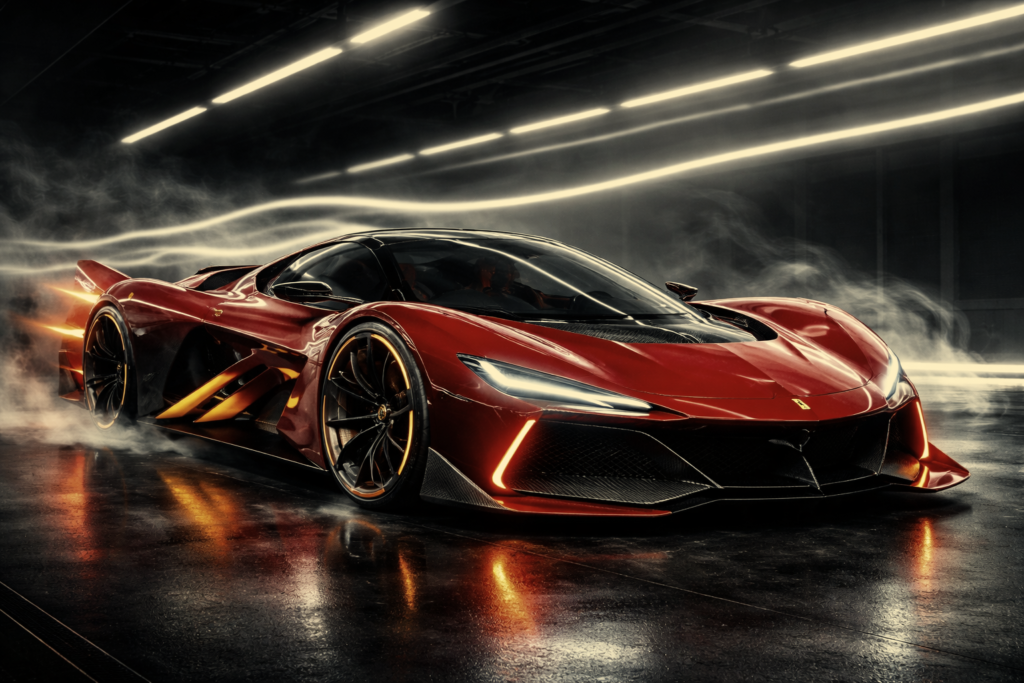
Ferrari is proving that the future of luxury cars can still be emotional. Their first fully electric supercar (expected late 2025/early 2026) will feature “Active Sound Enhancement,” using vibrations to mimic the soul-stirring sound of a V12 engine without the carbon emissions.
Lamborghini: The Hybrid Bull
Lamborghini is using “Supercapacitors” and hybrid tech (like in the Revuelto) to bridge the gap. By 2026, they will focus on “Active Aero-Morphing,” where the car’s body panels actually change shape to reduce drag and increase speed.
5. Investment Potential: Cars as Digital Assets
In the future of luxury cars, your vehicle is a financial asset. Much like the Future of Luxury Watches, rare cars are now being tracked on the blockchain.
Limited edition models from Pagani or Koenigsegg are sold out before they are even built. By 2026, these cars will come with a “Digital Twin” NFT, allowing owners to prove the car’s provenance and service history instantly, significantly increasing resale value.
6. Sustainable Luxury: The New Status Symbol
The old way of showing wealth was “Excess.” The future of luxury cars is about “Conscious Opulence.”
-
Vegan Leather: Brands like BMW are moving toward “Veganza” (leather made from cactus or pineapples).
-
Solar Paint: Self-healing paint that also acts as a solar panel to trickle-charge the car’s electronics while parked.
-
Recycled Wood: Using 5,000-year-old “Fenland Black Oak” pulled from bogs, ensuring no new trees are cut down.
7. The Autonomous Revolution: Level 5 and Beyond
By late 2026, we expect to see the first “Privileged Lanes” on highways specifically for Level 4 autonomous luxury vehicles. Imagine leaving London for Paris and sleeping the entire way in a bed inside your car. The future of luxury cars turns travel time into “found time.” You can work, sleep, or even host a dinner party while moving at 150 mph.
8. Price Trends: The Cost of the Future
Luxury is getting more expensive. While a high-end Mercedes might cost $150,000 today, the future of luxury cars post-2026 will see a new “Ultra-Luxury” tier starting at $500,000.
-
Bespoke Commissions: $1M – $5M (Unique 1-of-1 builds).
-
Electric Hypercars: $2.5M+ (Rimac, Pininfarina).
-
Luxury SUV EVs: $200k – $400k (The new daily driver for the elite).
See current luxury car market indices at DuPont Registry
9. Aesthetic Trends: Minimalism and Light
Visually, the future of luxury cars is moving away from aggressive grills and toward “Light Signatures.”
-
Invisible Headlights: Lights that are hidden behind the bodywork and only appear when turned on.
-
Glass Roofs with Adjustable Opacity: Using “Electrochromic Glass” to turn the roof from clear to pitch black with a swipe of a finger.
-
Aerodynamic Minimalism: No door handles, no mirrors (replaced by cameras), and a perfectly smooth silhouette.
10. Conclusion: Why the Future of Luxury Cars Matters
The future of luxury cars is a testament to human ambition. We are moving toward a world where the car is no longer a machine we operate, but a partner that understands us. In 2026 and beyond, your car will be the ultimate expression of your identity—sustainable, intelligent, and infinitely powerful.
Whether you are an investor looking for the next “Ferrari 250 GTO” or an enthusiast wanting the latest AI-driven comfort, the next five years will be the most exciting in automotive history. The road ahead is silent, electric, and incredibly luxurious.
Summary of Post-2026 Luxury Features:
-
Tech: Solid-State Batteries (10-min charge).
-
AI: Biometric Health Monitoring & Gesture Control.
-
Interior: 180-degree rotating seats & 8K Window Screens.
-
Sustainability: Mushroom-based interiors & Carbon-neutral manufacturing.
-
Investment: Every car comes with a Blockchain Digital Passport.
Explore the latest concepts at the Geneva International Motor Show
2 thoughts on “The Ultimate Evolution of Opulence: Why the Future of Luxury Cars Post-2026 is Redefining Status.”