Introduction: The Era of Digital Sovereignty
The Crypto Wallet Storage Guide is the most critical document any modern investor can read in 2026. As digital assets move from the fringes of finance into the heart of global portfolios, the question is no longer what to buy, but how to protect it. In an era where cyber-threats are evolving with AI-driven speed, your choice of storage is the only thing standing between your digital fortune and total loss.
This Crypto Wallet Storage Guide serves as your “Sovereign Vault” manual. Whether you are a “HODLer” of Bitcoin or a high-frequency DeFi trader, understanding the intricate balance between hot and cold storage is no longer optional—it is a fundamental skill for financial survival. By the end of this 2000-word deep dive, you will have the absolute clarity needed to secure your assets for the next decade.
1. A Detailed Crypto Wallet Storage Guide for 2026 Investors
At its core, a cryptocurrency wallet is not a physical pouch for digital coins. In the context of this Crypto Wallet Storage Guide, we define a wallet as a Biometric Keychain that holds your Private Keys. These keys are the mathematical proof on the blockchain that you own a specific asset.
In 2026, the mantra “Not your keys, not your coins” is more relevant than ever. This guide classifies wallets into two primary architectures: Hot (Online) and Cold (Offline).

2. Hot Wallets: The Pulse of Daily Transactions
A major part of any Crypto Wallet Storage Guide is explaining “Hot Storage.” These are wallets always connected to the internet. Think of them as your “Everyday Checking Account.”
Types of Hot Wallets in 2026:
-
Web-Based Super-Apps: Tools like MetaMask have evolved into full financial ecosystems.
-
Mobile MPC Wallets: Using Multi-Party Computation, these wallets allow you to recover funds without a seed phrase, using biometrics and social recovery.
-
Exchange-Custodial Wallets: While convenient, storing funds on an exchange like Binance or Coinbase means you are not the true owner of the keys.
Pros: Instant liquidity, easy for small payments, and perfect for interacting with AI-driven dApps.
Cons: Susceptible to phishing, malware, and “zero-day” browser exploits.
3. Cold Wallets: The “Fort Knox” of the 2026 Digital Economy
No Crypto Wallet Storage Guide is complete without emphasizing Cold Storage. These are offline devices that never touch the internet, providing a physical “air-gap” against hackers.
Why Cold Storage is Non-Negotiable:
In 2026, as quantum computing begins to threaten traditional encryption, the physical isolation of a cold wallet is the ultimate defense.
-
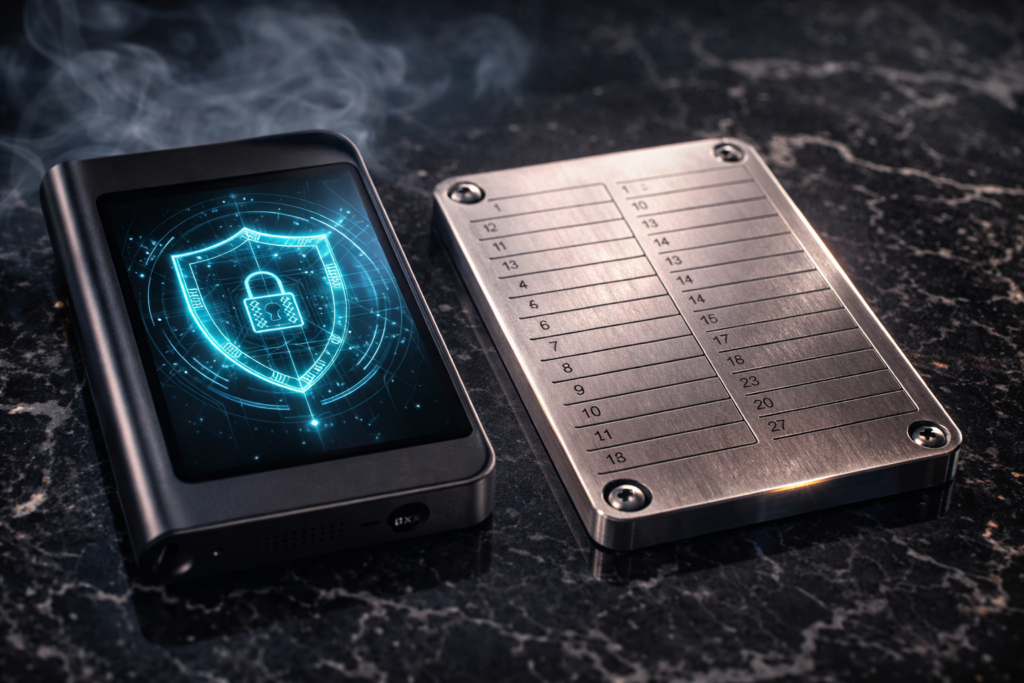
Hardware Wallets (HWW): Devices like the Ledger Stax or Trezor Safe 3 use “Secure Element” chips (the same tech in passports).
-
Air-Gapped QR Wallets: These devices, like the Keystone, communicate only via QR codes, meaning no physical connection (USB/Bluetooth) is ever made to a computer.
-
Metal Backups: Moving away from paper, this Crypto Wallet Storage Guide recommends titanium plates to store your 24-word recovery phrase to ensure fireproof and floodproof security.
4. Comparative Analysis: Hot vs. Cold Storage Matrix
| Feature | Hot Wallet (Active) | Cold Wallet (Fortress) |
| Connectivity | Connected to 6G / Cloud | Air-Gapped / Offline |
| Primary Use | Daily trading & DeFi | Multi-year HODLing |
| Security Risk | Medium to High | Extremely Low |
| Recovery Method | Social Recovery / Email | 24-Word Seed / Metal Backup |
| Cost | Free (Software) | $79 – $250 (Hardware) |
| Best For | Assets under $10,000 | Life savings & Blue-chip NFTs |
5. Revolutionary 2026 Technology: MPC and Account Abstraction
The most exciting update in this Crypto Wallet Storage Guide is the rise of Account Abstraction (ERC-4337).
Previously, if you lost your “Seed Phrase,” your money was gone forever. In 2026, smart-contract wallets allow for “Social Recovery.” You can designate “Guardians” (trusted friends or your own hardware wallets) to help you regain access to your account without needing a paper backup. This makes the Crypto Wallet Storage Guide accessible to the average person, not just tech experts.
Read Our Trending Blog: How AI-driven security is changing the way we Earn Money with AI Tools.
6. Brand Reviews: The Best Tools of 2026
To make this Crypto Wallet Storage Guide practical, let’s look at the hardware leaders:
-
Ledger Stax Pro: With its curved E-Ink display, it allows you to sign transactions with a clear view of what you are doing.
-
Trezor Safe 5: The gold standard for open-source fans who want to verify every line of code protecting their money.
-
Blockstream Jade: For Bitcoin purists, this is the most affordable and secure air-gapped device on the market.
-
BitBox02: A Swiss-made powerhouse known for its minimalism and high-grade security audits.
7. Step-by-Step Security Setup: A Crypto Wallet Storage Guide Routine
Follow this “Fortress Protocol” to ensure your funds are never compromised:
-
Step 1: Buy Direct. Never buy a wallet from Amazon or eBay. Only buy from the manufacturer’s official site.
-
Step 2: Generate Offline. Set up your hardware wallet on a “Clean” computer or via the device’s own screen.
-
Step 3: The $10 Test. Send $10 to the wallet. Delete the wallet from the device. Recover it using your seed phrase. If the $10 is still there, you know your backup works perfectly.
-
Step 4: Metal Storage. Engrave your seed phrase on a titanium plate.
-
Step 5: Multisig. For amounts over $500,000, use a “Multisig” setup (2-of-3 wallets required to move funds).
8. The Psychology of Self-Custody: Control is the New Luxury
In the 2026 economy, autonomy is the ultimate status symbol. Much like owning the Future of Luxury Cars, owning your private keys is about freedom.
This Crypto Wallet Storage Guide emphasizes that “Self-Custody” means you are your own bank. You are not subject to bank holidays, frozen accounts, or central bank devaluations. However, with great power comes the responsibility of being your own security guard.
9. Security Risks: Phishing and AI Scams
Even the best Crypto Wallet Storage Guide cannot protect you from “Social Engineering.” In 2026, scammers use “Deepfake” voices of exchange CEOs to trick you into revealing your seed phrase.
-
Golden Rule: A hardware wallet company will NEVER ask for your 24-word seed phrase.
-
Zero-Trust Policy: Never click links in emails. Always go directly to the official website of your wallet provider.
10. The Road Beyond 2026: Post-Quantum Cryptography
As we look toward 2030, the Crypto Wallet Storage Guide will shift toward “Quantum Resistance.” Future wallets will use lattice-based cryptography to stay ahead of supercomputers. If you are buying a wallet today, ensure it is “Firmware Upgradeable” so you can stay secure as technology evolves.
Conclusion: Mastering Your Digital Fortune
This Crypto Wallet Storage Guide has laid out the path to total digital security. By balancing the speed of hot wallets with the unshakeable safety of cold storage, you are prepared for whatever the 2026 economy throws at you.
Your digital assets are more than just numbers on a screen; they are the foundation of your future wealth. Treat them with the respect they deserve. Secure them today, so you can enjoy them tomorrow.
FAQ: Navigating the Crypto Wallet Storage Guide
Q1: What happens if the hardware wallet company goes out of business?
A: Your funds are safe. Most wallets follow the “BIP-39” standard. You can simply take your 24-word seed phrase and import it into any other brand’s wallet (like Trezor or Ledger) to get your money back.
Q2: Should I use a “Passphrase” (25th word)?
A: Yes. This Crypto Wallet Storage Guide highly recommends a passphrase. It acts as an “extra lock” that isn’t written down on your seed plate, protecting you even if someone finds your physical backup.
Q3: Is a phone-based wallet safe for $5,000?
A: It is acceptable for small amounts, but for anything over $1,000, we recommend a $79 hardware wallet as a safer alternative.